Compound Interest Calculator
See how your savings and investments grow over time with the power of compound interest. Change any input and the results update instantly — no sign-up.
How compound interest works
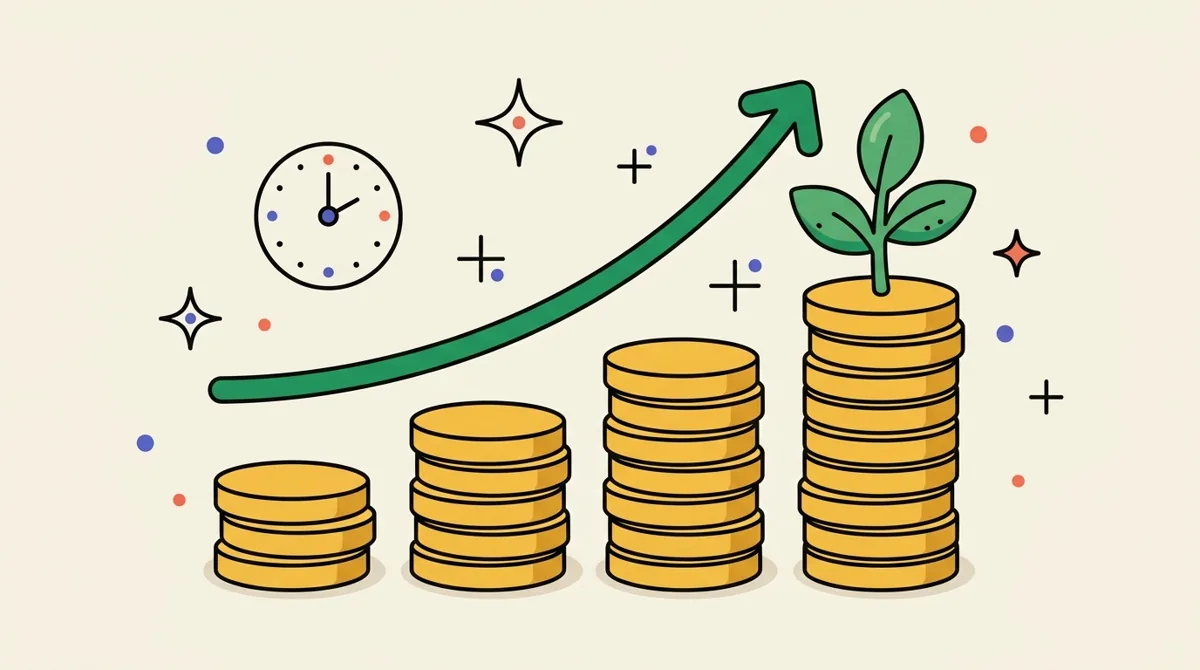
Compound interest is often called the eighth wonder of the world. Unlike simple interest, which only earns returns on your original deposit, compound interest earns returns on your returns. Over time, this creates exponential growth that can turn modest savings into substantial wealth.
The compound interest formula
The formula for compound interest with regular contributions is: FV = P(1 + r/n)^(nt) + PMT × [((1 + r/n)^(nt) − 1) / (r/n)], where P is the initial principal, r is the annual rate, n is compounding frequency, t is time in years, and PMT is the periodic contribution.
The Rule of 72
The Rule of 72 gives you a quick mental shortcut: divide 72 by your annual interest rate to estimate how many years it takes to double your money. At 6%, your money doubles in roughly 12 years. At 10%, it doubles in about 7.2 years. This rule works best for rates between 4% and 12%.
Compound vs simple interest
With simple interest, a $10,000 deposit at 7% earns exactly $700 per year — $14,000 in interest over 20 years. With compound interest (compounded monthly), that same deposit earns over $28,000 in interest. The difference grows dramatically over longer time periods, which is why starting early matters so much.
Tip: Even small monthly contributions add up. Contributing $200/month at 7% for 30 years results in over $243,000 — but only $72,000 of that is your money. The rest is compound interest doing the heavy lifting.
Compounding frequency matters (a little)
Monthly compounding produces slightly more growth than annual compounding, and daily compounding edges out monthly — but the differences are small. The real drivers of compound growth are your rate of return, time horizon, and consistent contributions. Focus on those first.